Kimi K3 Launch Recap: What Moonshot Shipped on July 16
Last updated:
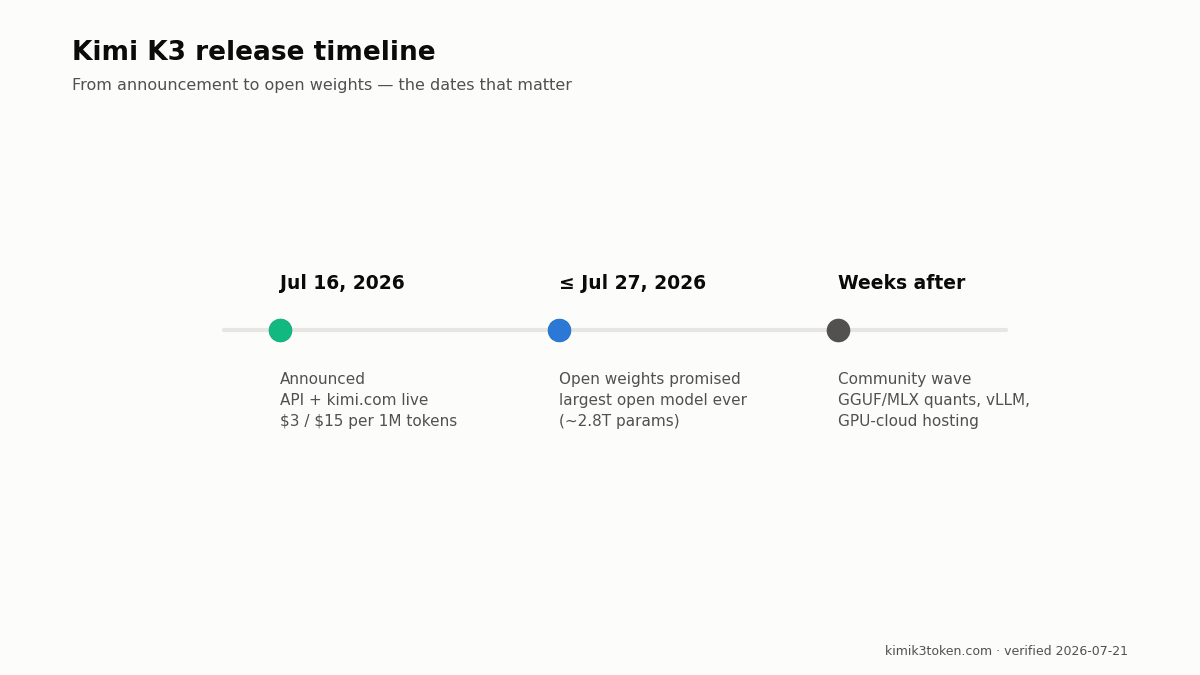
The short version: on July 16, 2026 Moonshot AI announced Kimi K3 — a roughly 2.8-trillion-parameter mixture-of-experts model with a 1,048,576-token context window and image input, priced at $3 per million input tokens and $15 per million output tokens, with open weights promised by July 27. It scored an Elo of 1547 on Artificial Analysis private evaluations, a jump of about +732 points over Kimi K2.6. Here is what's confirmed, what's self-reported, and what it means for your budget.
What's confirmed
Availability was immediate: K3 went live on kimi.com, the Kimi apps and the developer API on announcement day,
and OpenRouter listed moonshotai/kimi-k3 with pass-through pricing dated July 15. The API is
OpenAI-compatible, launches with a single "max" reasoning effort level, and accepts text and images.
The scale claim is the headline. Moonshot markets K3 as the first open model of the "3T class" — if the July 27 weights drop happens as promised, it will be the largest open-weight model ever published, comfortably ahead of DeepSeek's 1.6T V4 family. The architecture notes on the OpenRouter listing mention KDA (Kimi Delta Attention) and attention residuals as the efficiency tricks that make the 1M window practical.
What's self-reported (read with care)
Moonshot's launch table shows K3 mostly ahead of Claude Opus 4.8 (max) and GPT-5.5 (high), while trailing the newest closed flagships. Community testing added color the same week: K3 took the top spot on Arena.ai's Frontend Code arena, and early testers found evidence of an 85-token hidden system prompt that the model politely refuses to reveal. None of the launch benchmarks have been independently reproduced yet — that starts when the weights land. Our benchmarks tracker separates the confirmed from the claimed and gets updated as third-party numbers arrive.
The pricing math that actually matters
K3 costs 3.2× more than K2.6 on input and 3.75× more on output. Two details soften that sticker shock. First, Moonshot reports K3 completes matched tasks with about 21% fewer output tokens than K2.6 — and since output is the expensive meter at $15/M, real bills rise less than the sticker multiplier suggests. Second, prompt caching discounts repeated input, which dominates agentic workloads; the official K3 cached rate hasn't been published yet, so treat all cache math as estimated for now.
Concretely: a 10K-input / 1K-output request costs about $0.045 on K3 versus $0.0135 on K2.6 before caching. Whether that 3.3× premium pays for itself depends entirely on whether K3's quality saves you iterations — run your own volumes through the cost calculator rather than guessing, and check prompt sizes with the token calculator.
What to watch next
Three dates and datapoints worth tracking: the July 27 weights release (our local deployment guide covers the realistic hardware math for a 2.8T MoE); the first independent benchmark reruns that follow it; and the official cached-input price, which will decide whether K3 agent loops are economical at scale. We'll cover each as it happens — the pricing page and this blog are updated the day numbers change.
Frequently asked questions
What did Moonshot release on July 16, 2026?
Moonshot AI announced Kimi K3 — a ~2.8T-parameter open-weight MoE model with a 1M-token context window and image input — with immediate availability on kimi.com and the API, and open weights promised by July 27.
How much did pricing change from Kimi K2.6 to K3?
Input went from $0.95 to $3.00 per million tokens (3.2×) and output from $4 to $15 (3.75×). Moonshot says K3 uses about 21% fewer output tokens on matched tasks, which partially offsets the increase.