Kimi K3's context window, in real units
Last updated:
Kimi K3's context window is 1,048,576 tokens (1M). In practical terms that is roughly 1,500–2,000 pages of prose, 7–8 novels, or a 50K-line codebase in a single request — and filling it completely costs about $3.15 of input at the $3/M rate. Numbers that big stop meaning anything, so this page converts the window into units you already think in.
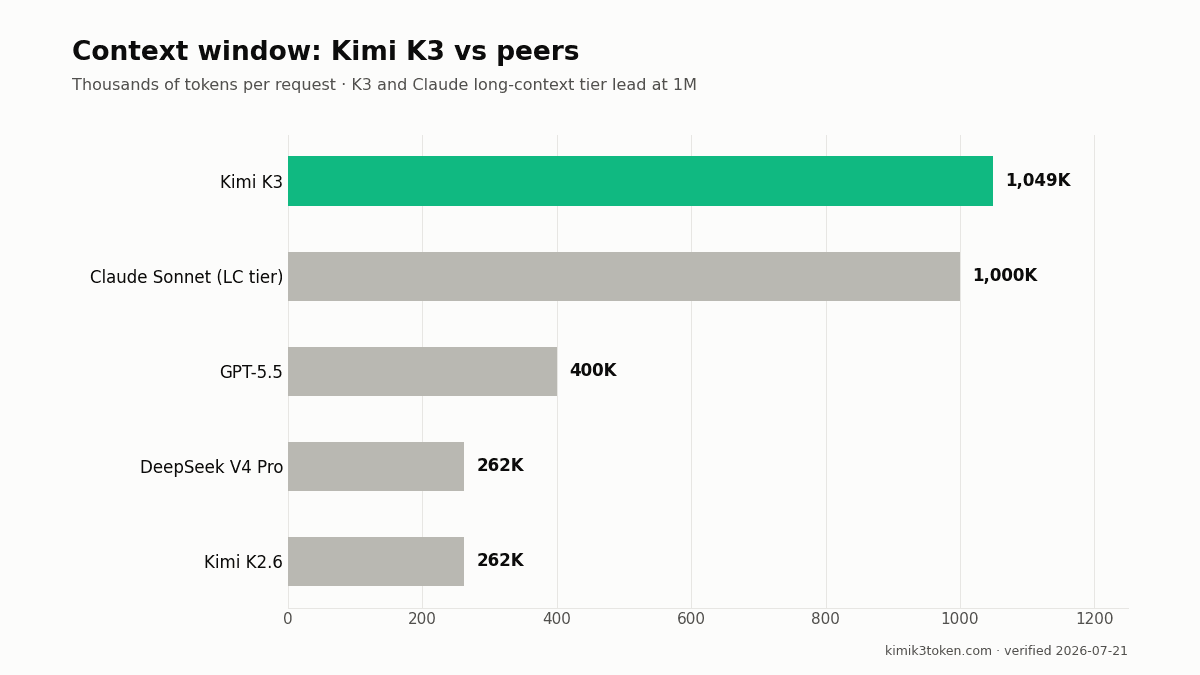
What fits in 1,048,576 tokens
| Content | Approx. tokens | Fits in K3's window |
|---|---|---|
| Dense printed page (~600 words) | ≈500–700 | ~1,500–2,000 pages |
| Average novel (~90K words) | ≈120K–140K | ~7–8 novels |
| The entire Lord of the Rings trilogy | ≈750K | yes, with room to spare |
| 50K-line TypeScript codebase | ≈600K–800K | usually in one shot |
| 1-hour meeting transcript | ≈8K–12K | ~90–130 hours |
| Typical PDF research paper | ≈8K–15K | ~70–130 papers |
Estimates assume typical English BPE density (≈1.3 tokens/word; code varies more). Paste your own material into the token calculator for exact counts — these rows are planning aids, not billing math.
The economics of a huge window
A full window is $3.15 of input per request, which sounds trivial until an agent loop resends it hundreds of times a day: 300 fully-loaded steps daily is ~$28,000/month before caching. This is precisely why Moonshot's prompt caching matters and why our cost calculator treats cache hit rate as a first-class input. The realistic pattern for repo-scale agents — send the whole codebase once, then iterate with cached context — keeps the marginal step cost in cents.
When to use it — and when not to
The 1M window shines where chunking pipelines are brittle: whole-repository refactoring, multi-document due diligence, long-horizon agent sessions with image inputs (screenshots, logs) mixed in. It is the wrong tool when a retrieval step could deliver the same answer from 5K tokens — you would be paying 200× the input cost for convenience. Most production systems land in between: a generous-but-curated context in the tens of thousands of tokens, cached aggressively. For the raw rates behind these numbers see Kimi K3 pricing; for what the model itself can do with the window, see our K3 overview.
Frequently asked questions
How big is Kimi K3's context window?
1,048,576 tokens (2^20, commonly written as 1M), per the OpenRouter model listing. That covers both your input and the model's output within a single request.
How many pages of text fit in Kimi K3's context?
A dense A4/letter page runs roughly 500–700 tokens, so 1M tokens holds on the order of 1,500–2,000 pages — several full-length novels or a year of meeting transcripts in one request.
What does it cost to fill Kimi K3's entire context window?
1,048,576 input tokens at $3 per million is about $3.15 per fully-loaded request before caching. With a warm cache the repeated portion is billed at the discounted cached rate, which is what makes repo-scale agent loops economical.
Is a bigger context window always better?
No. Retrieval quality typically degrades somewhere in very long contexts, latency grows, and you pay for every token whether the model needed it or not. The practical pattern is: use the big window to avoid brittle chunking, but still trim irrelevant content.